Four Faces of Fear
For a long time I believed fear was one thing — a single alarm, and the goal was always to turn it off as fast as I could. Brace, avoid, push through. That’s how most of us are taught to handle it.
But fear isn’t one thing. And treating it like it is may be exactly why it doesn’t resolve.
Not all fear is lying to you. Some of it is the only part of you still telling the truth.
Here are the four faces of fear I’ve come to recognize — in my own body, and in the people I work with.
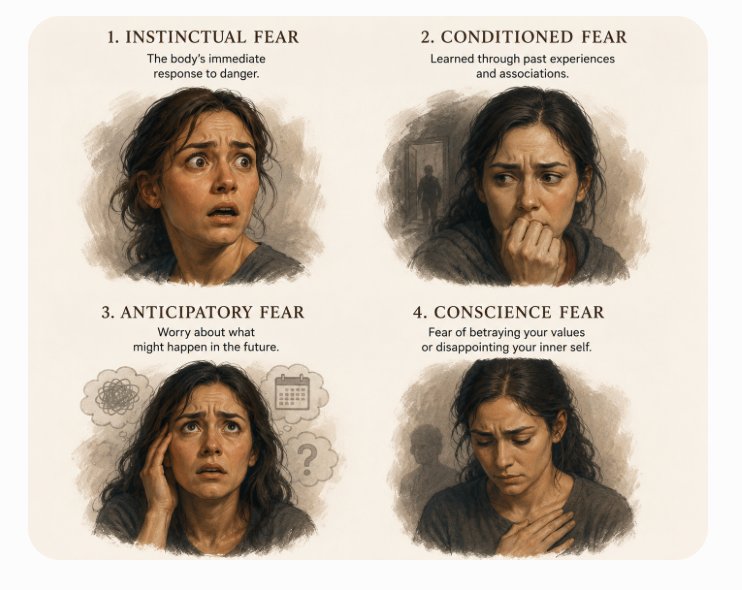
1. Instinctual Fear
This is the oldest face. Purely protective, immediate — the sharp jolt when something in front of you is actually dangerous. It resolves the moment the threat passes. There’s nothing to fix here. This is just the body doing exactly what it was built to do.
2. Conditioned Fear
This one is old evidence, replayed in the present. It shows up as a familiar tightness, disproportionate to what’s actually happening right now. The pattern is simple once you see it: you’re reacting to a memory wearing today’s clothes.
3. Anticipatory Fear
This face feeds only on the unknown — on imagined futures that haven’t happened yet. It feels restless, looping, ungrounded, and it can’t be resolved by facts because it was never about facts in the first place. Here’s the turn: this fear starves the moment you make a decision. It thrives only on the undecided.
4. Conscience Fear
This is the one that’s different from the other three — and it’s the one I had to learn to stop arguing with.
I spent a long time carrying Mary Burmeister’s words like a stone I couldn’t put down: fear is false evidence appearing real. I wanted that to be true. I tried it on the way you try on a coat that’s supposed to fit. It didn’t. And for years I thought that meant something was wrong with me.
That was the first disconnect I felt with Jin Shin.
Because some of the fear I carried wasn’t false evidence of anything. It was accurate. It was my own internal compass, correctly reporting that something in my life was out of alignment with what I knew to be true. The fear wasn’t lying to me. It was the only part of me still telling the truth.
Conscience fear rises from a gap between what you’re doing and what you know. It feels quiet, heavy, almost decapitating — and it drains your life energy specifically because it’s being ignored, not because it’s wrong. This fear doesn’t want to be managed. It wants to be listened to. It’s asking you to look, not to run.
This is the fear our hands can teach us to sit with, instead of silencing it.
The Bridge Back
Our hands are always-available access points back to ourselves — Return Points, ready whenever we need them. When you’re not sure which face of fear you’re looking at, the practice isn’t to fight it. It’s to return, and let the body sort what the mind can’t yet name.
The Threshold
There’s an image from the I Ching I keep coming back to: crossing the ice, almost to the far shore. The light of understanding isn’t a finish line you cross once — it’s a threshold you keep crossing, carefully, again and again. Fumble it, rush it, assume you’re already done, and you’re back in the water.
Real empowerment isn’t the arrival. It’s the ongoing crossing.
Tamaso ma jyotirgamaya — from darkness, lead me to light.
Want to feel this in your own hands? Try the Fear hold — the Index Finger practice — and notice which face shows up for you.